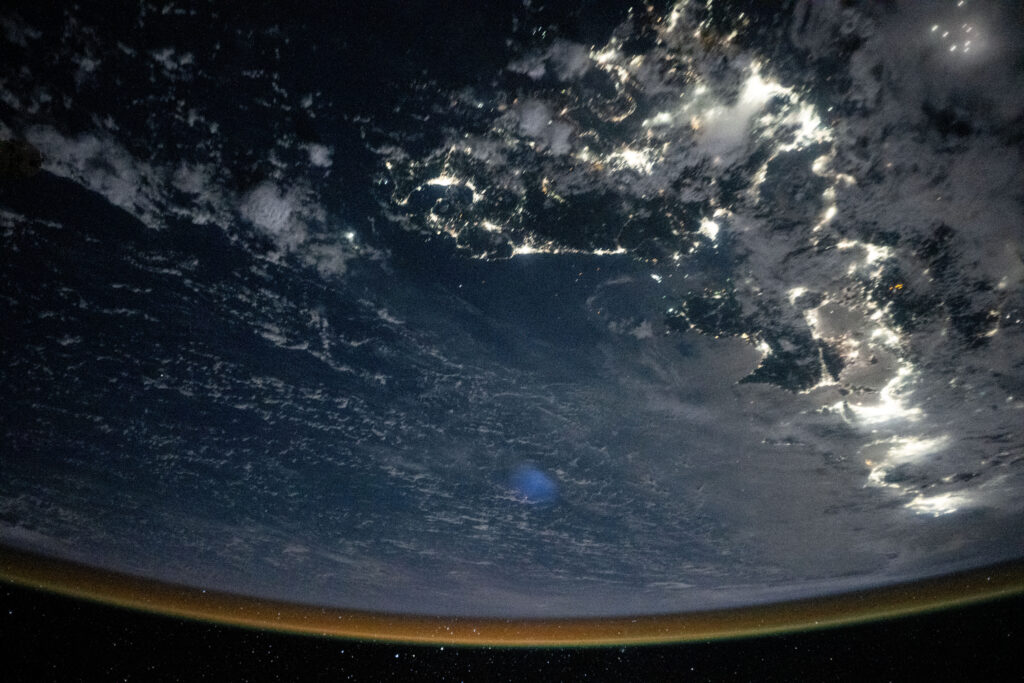
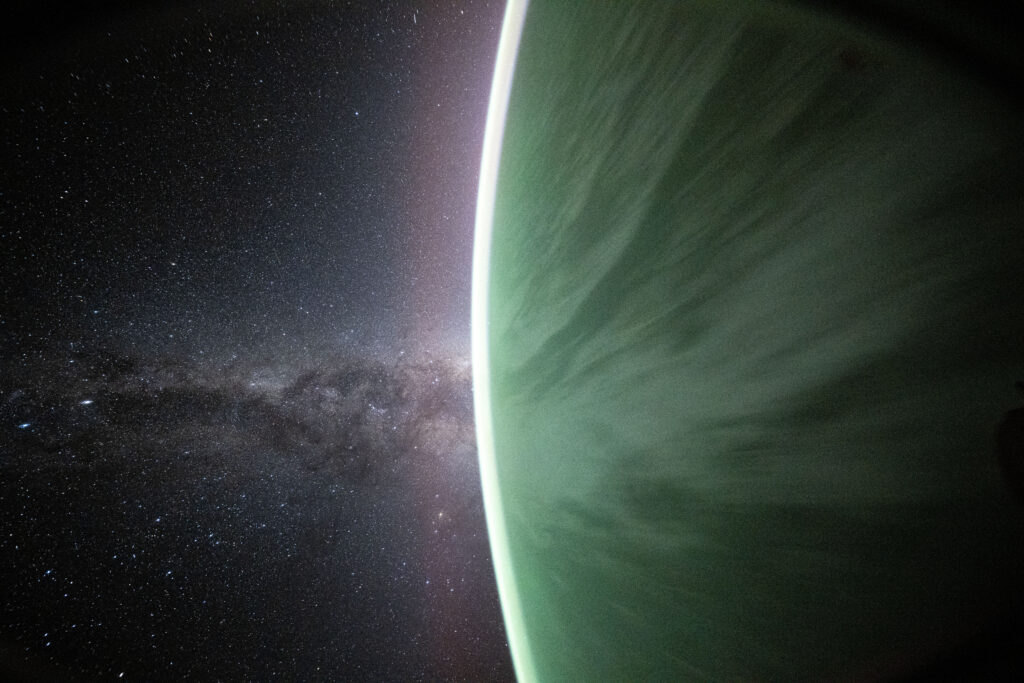
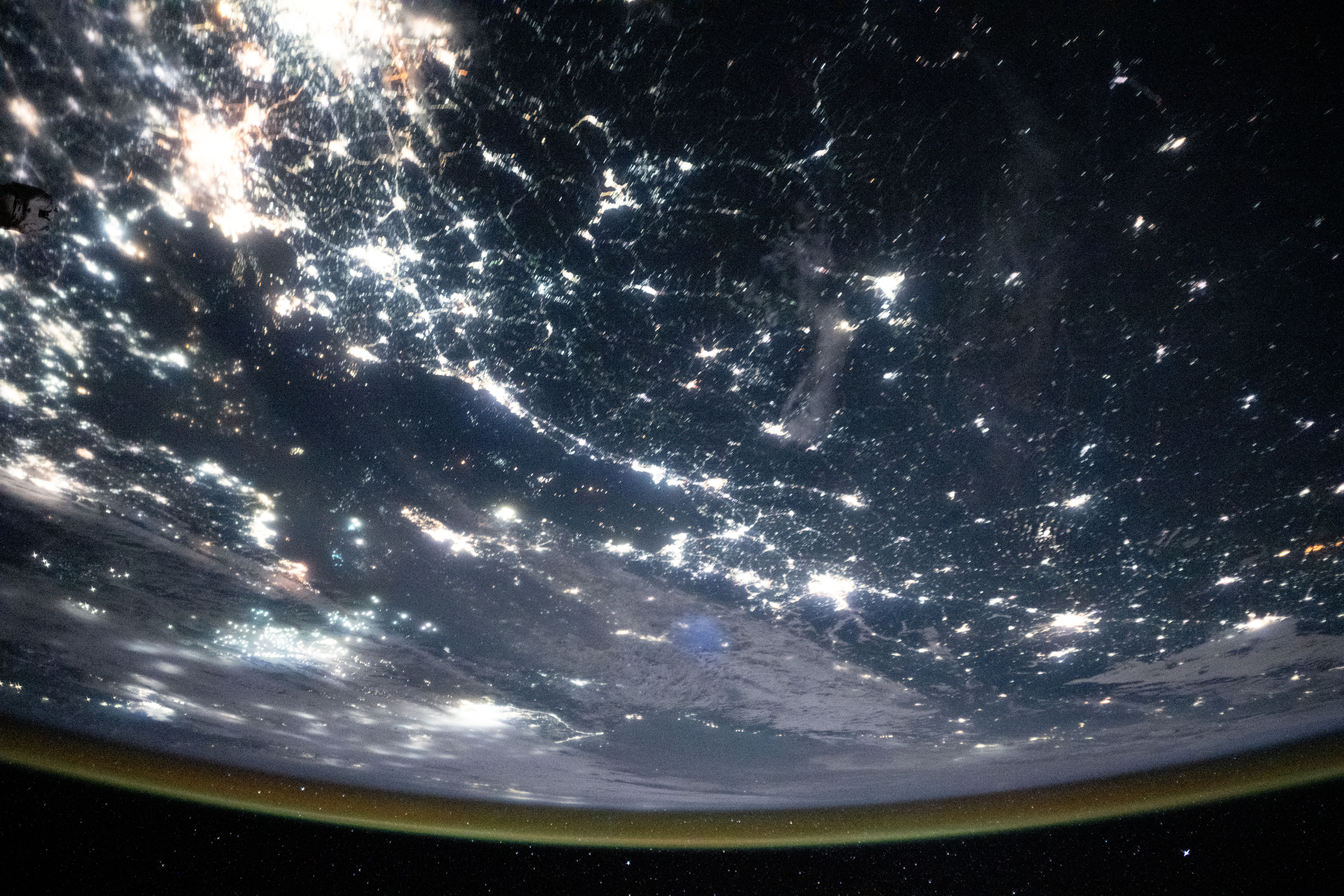
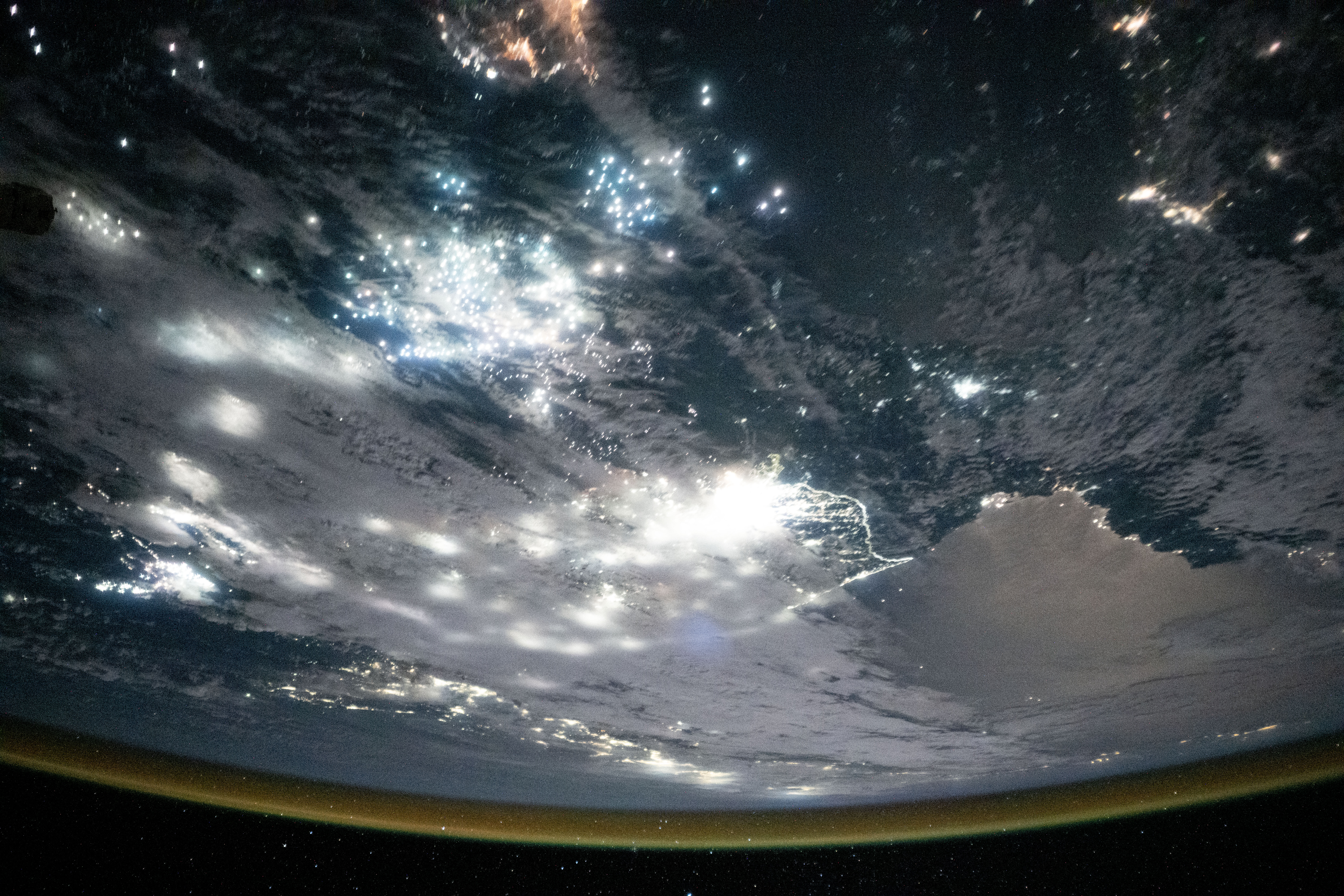
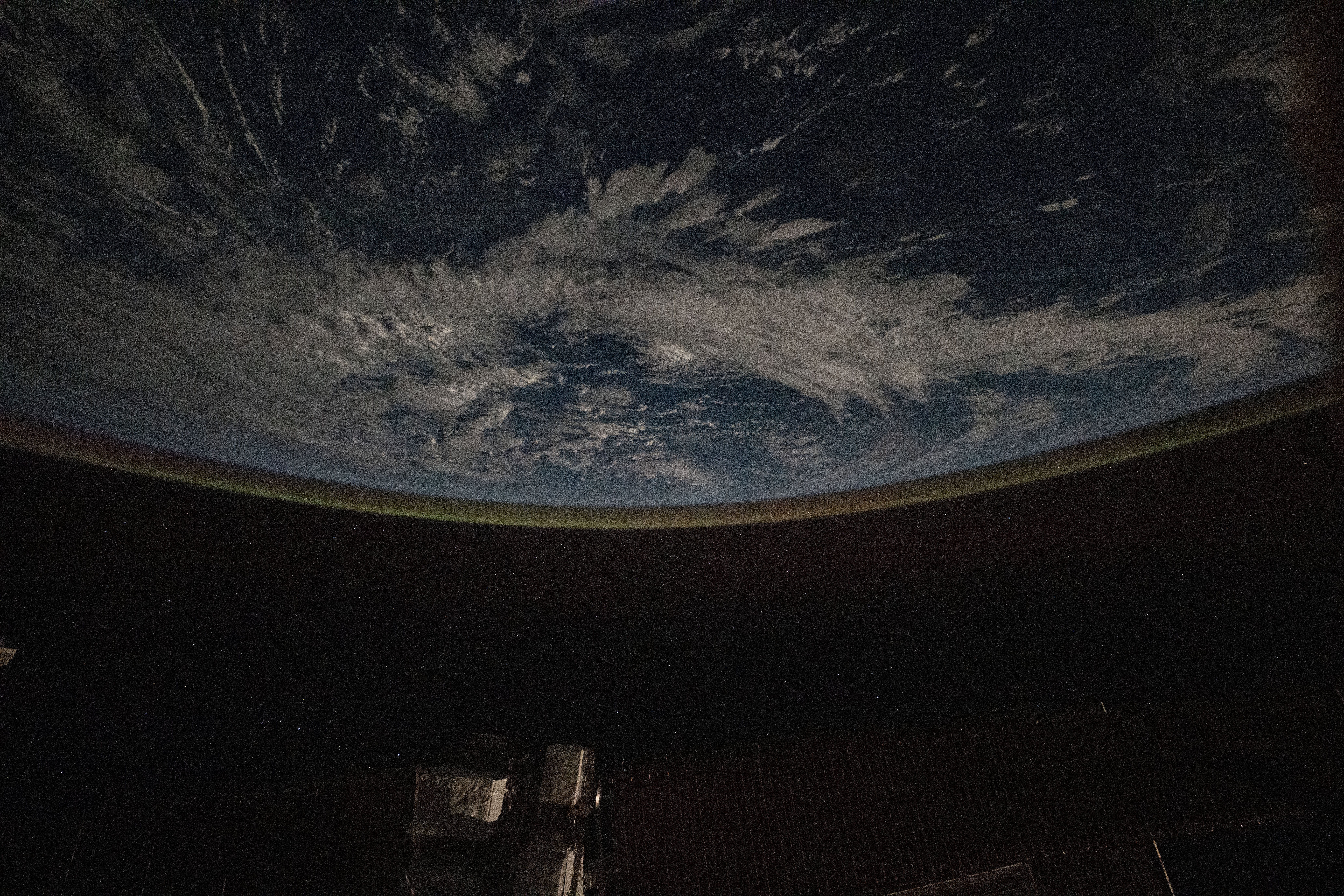
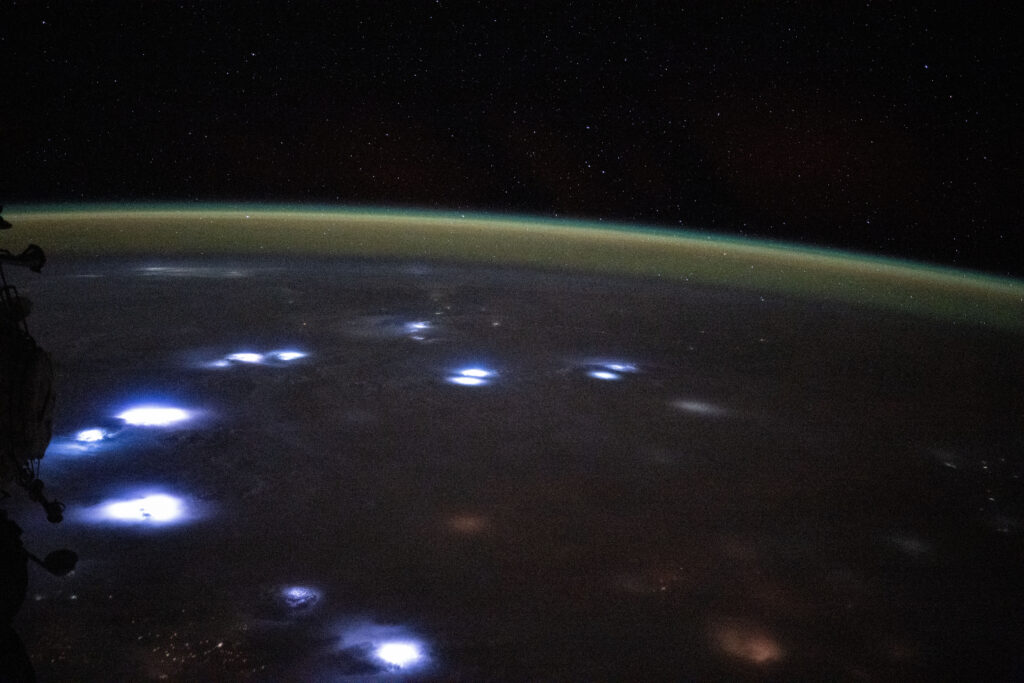
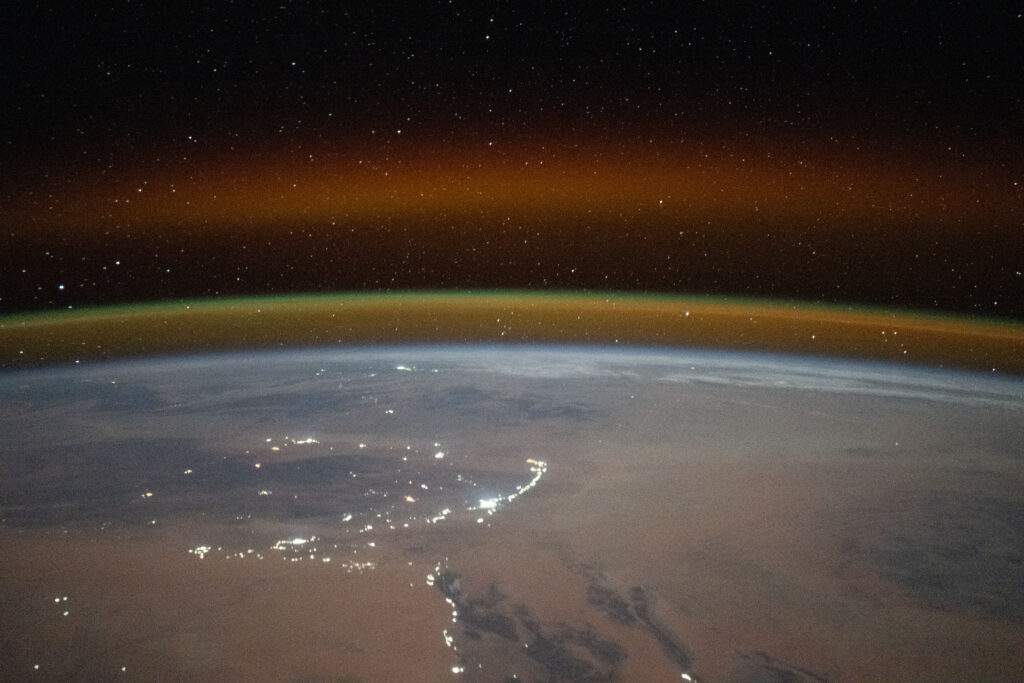
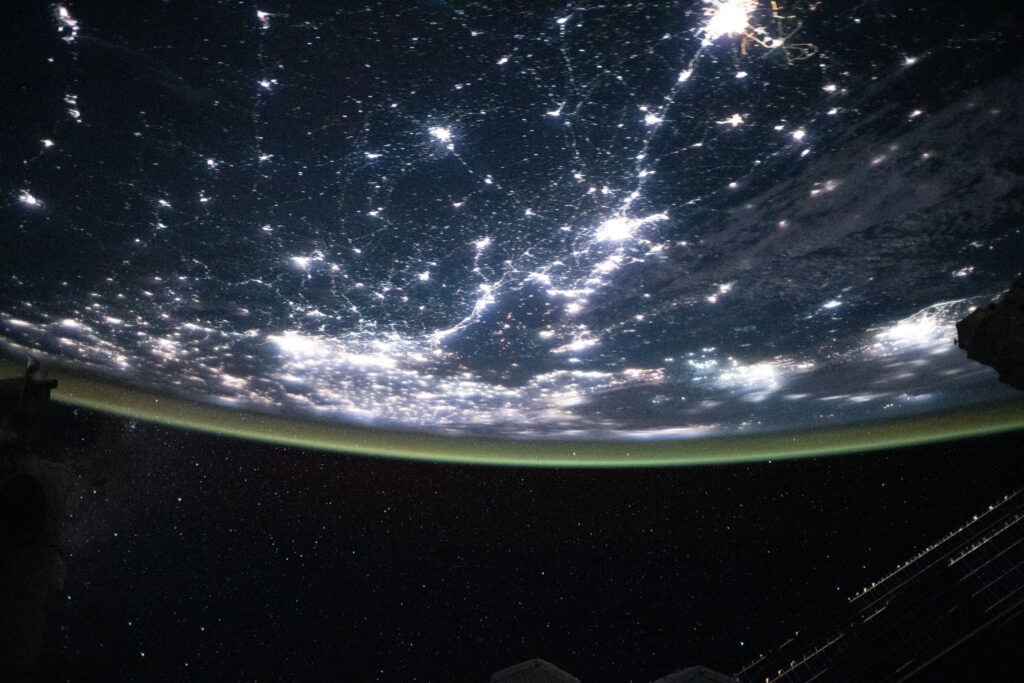
iss073e0824492 (Sept. 14, 2025) — In this oblique view from the International Space Station, city lights outline southern Japan from Fukuoka (top right) to Tokyo (bottom right) with a red-yellow airglow blanketing Earth’s horizon. This natural glow is produced when solar ultraviolet radiation excites oxygen molecules in the upper atmosphere during the day, which then release that energy as visible light at night. The orbital outpost was soaring 261 miles above the East China Sea at approximately 1:45 a.m. local time when this photograph was taken.iss072e574663 (January 29, 2025) — The Earth appears green due to the Aurora Australis, while the Milky Way rises over the horizon. This long exposure image was captured while the International Space Station was orbiting over the southern Pacific.iss073e0824130 (Sept. 14, 2025) — The Korean Peninsula—highlighted by Seoul, South Korea (bottom left)—and Northeast China—illuminated by the Beijing Municipality (top left)—are pictured from the International Space Station as it orbited 262 miles above Asia at approximately 12:42 a.m. local time.iss073e0824280 (Sept. 14, 2025) — The well-lit border (center) between South Korea and the less-illuminated North Korea is framed by the moonlit Sea of Japan (bottom) and the Yellow Sea (top), which is dotted with the bright lights of fishing boats. These lights are used to attract nocturnal fish, including anchovies, mackerel, and squid. The International Space Station was orbiting 262 miles above the Bohai Sea at approximately 12:43 a.m. local time when this photograph was taken.iss073e0780028 (Sept. 2, 2025) — A faint airglow blankets Earth’s horizon in this photograph taken from the International Space Station as it orbited 259 miles above the Pacific Ocean between Hawaii and California. This natural glow is produced when solar ultraviolet radiation excites oxygen molecules in the upper atmosphere during the day, which then release that energy as visible light at night.iss073e0816985 (Sept. 27, 2025) — Bright lightning storms illuminate the cloudy landscape of western Africa in this image captured from the International Space Station. A soft yellow-green atmospheric glow, created by atoms and molecules releasing energy absorbed from solar radiation earlier in the day, blankets Earth’s horizon. The orbital outpost was soaring 260 miles above the Atlantic coast of Ghana at approximately 11:04 p.m. local time when this photograph was taken.iss073e1198938 (Nov. 28, 2025) — A yellow-red airglow blankets Earth’s horizon as village lights dot the Saharan landscape of Algeria in this photograph taken at approximately 8:50 p.m. local time from the International Space Station as it orbited 261 miles above north Africa.iss073e0820756 (Sept. 14, 2025) — The densely urbanized region surrounding the Bohai Sea (center) on China’s east coast includes several major metropolitan areas, from Beijing (left center) to Changchun (top right), and Seoul, South Korea (far right). A yellow-green airglow blankets Earth’s horizon in this image captured from the International Space Station as it orbited 263 miles above the surface at approximately 11:06 p.m. local time.iss073e0817052 (Sept. 27, 2025) — Warm, diffuse city lights and bright lightning storms illuminate the cloudy nighttime landscape of western Africa in this image captured from the International Space Station. A soft yellow-green atmospheric glow, created by atoms and molecules releasing energy absorbed from solar radiation earlier in the day, blankets Earth’s horizon. The orbital outpost was soaring 260 miles above the Atlantic Ocean at approximately 11:05 p.m. local time when this photograph was taken.These false-color image taken by NASA’s Spitzer Space Telescope shows the ‘South Pillar’ region of the star-forming region called the Carina Nebula.The dusty side of the Sword of Orion is illuminated in this striking infrared image from the European Space Agency’s Hershel Space Observatory.This image from NASA’s Spitzer Space Telescope shows the Orion nebula, our closest massive star-making factory, 1,450 light-years from Earth. The nebula is close enough to appear to the naked eye as a fuzzy star in the sword of the constellation.This image from NASA’s Spitzer Space Telescope shows infant stars hatching in the head of the hunter constellation, Orion.NASA’s Hubble Space Telescope captures the chaotic activity atop a three-light-year-tall pillar of gas and dust that is being eaten away by the brilliant light from nearby bright stars in a tempestuous stellar nursery called the Carina Nebula.These false-color image taken by NASA’s Spitzer Space Telescope shows the ‘South Pillar’ region of the star-forming region called the Carina Nebula.CAPE CANAVERAL, Fla. – Twin columns light the night sky as space shuttle Endeavour hurtles into space on the STS-126 mission. Liftoff was on time at 7:55 p.m. EST. STS-126 is the 124th space shuttle flight and the 27th flight to the International Space Station. The mission will feature four spacewalks and work that will prepare the space station to house six crew members for long-duration missions. Photo credit: NASA/Sandra Joseph-Kevin O’ConnellKENNEDY SPACE CENTER, FLA. -Space Shuttle Endeavour roars into the black sky on columns of fire as it lifts off Launch Pad 39A on mission STS-113. Liftoff occurred ontime at 7:49:47 p.m. EST. The launch is the 19th for Endeavour, and the 112th flight in the Shuttle program. Mission STS-113 is the 16th assembly flight to the International Space Station, carrying another structure for the Station, the P1 integrated truss. Also onboard are the Expedition 6 crew, who will replace Expedition 5. Endeavour is scheduled to land at KSC after an 11-day journey. [Photo by Scott Andrews]